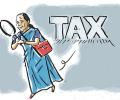
Gross direct tax collection in 2022-23 rose by around 20 per cent to Rs 19.68 lakh crore, exceeding the government's revised collection target. Buoyed by personal income tax collection, the gross collection has exceeded the revised estimates (RE), set on February 1, by Rs 2.41 lakh crore or by 16.97 per cent. After adjusting for refunds, the net income tax paid by individuals and corporate, showed an increase of 18 per cent to Rs 16.61 lakh crore during the fiscal, which ended March 31, 2023.

Party leader Rahul Gandhi dubbed the Union Budget as a 'zero-sum budget', saying it has nothing for the salaried, middle class and the poor.

The government on Tuesday proposed to extend the period of incorporation of eligible startups by one more year till March 31, 2023 for providing tax incentives, a move aimed at encouraging budding entrepreneurs. Finance Minister Nirmala Sitharaman in her Budget speech said startups have emerged as drivers of growth for the economy and over the past few years, the country has seen a manifold increase in successful startups. Eligible startups established before March 31, 2022 had been provided a tax incentive for three consecutive years out of ten years from incorporation.

'Asset allocation should be driven much more by long-term factors rather than the market scenario at any particular point in time.'

Budget has already bombed at the box office and passing it without a revisit will be a mockery of the exercise though any modification may be short lived and perfunctory, observes V Ranganathan.

The IT and ITeS sectors expect a reduction in minimum alternate tax (MAT) and dividend distribution tax in the next month's Union Budget, a senior economist said on Tuesday.

The idea is to introduce in the next Budget a number of safeguards for preventing disputes with taxpayers.

The challenges before the coming Budget are more daunting than those in 2021, reveals A K Bhattacharya.

With the Budget just a little over a week away, the Indian realty sector has lined up its wish-list which include a tax holiday under Section 80-1B for affordable housing, promoting real estate mutual funds and clarity on introduction of a real estate regulator, among others.

If growth reverts to the pre-Covid level, a lot of people may have to temper their rosy optimism, points out Debashis Basu.

Congress leader and ex-finance minister P Chidambaram on Tuesday said the Union Budget was the "most capitalist" with nothing for the poor and farmers while sops were being provided to big industrialists turning India into a very "unequal country". At a press conference after Union Finance Minister Nirmala Sitharaman unveiled a Rs 39.45 lakh crore Budget, he said because of the ruling party's "brute majority" the Lok Sabha pass the Budget but people will reject it. He claimed the Bharatiya Janata Party was going to elections, scheduled in five states, not with their performance or with the promises and assurances to the people, but solely "with the agenda of dividing the country and bringing Hindutva back to power".

What stood out in his 15-year journey as a member of the political executive at the Centre was his glowing record as India's most successful and effective finance minister. Both as prime minister and finance minister, he understood the importance of gradualism, except when the economy or the polity was in a crisis.

Exporters on Thursday demanded fiscal incentives, tweaking in customs duties on certain products and credit at affordable rates in the forthcoming Budget to boost exports and create jobs. In a pre-budget virtual meeting with Finance Minister Nirmala Sitharaman, the Federation of Indian Export Organisations (FIEO) said the depreciation of the rupee against the US dollar is affecting exports' competitiveness and the sector requires more support. "Creation of employment is the biggest challenge faced by the country...We would urge the government to provide fiscal support to units which provide additional employment in the export sector," the exporter's body said.

The government expects indirect tax collection to be lower than the Budget Estimate (BE) of Rs 13.38 trillion this fiscal year, despite prospects of netting goods and services tax (GST) in large amounts, Revenue Secretary Tarun Bajaj has said. "Indirect tax collection may see lower realisation than budgeted on account of cuts in excise and customs duties. "We could see a shortfall of about Rs 1.5 trillion on account of those," he told Business Standard.

'There is a vision in the Budget, and the vision is to take India from a largely agrarian, rural economy into a fast-track digitalised economy.'

The party said it is "considering opposing" the proposal for taxing the PF corpus in Parliament.

The Centre may overshoot the Rs 56,260 crore target for dividend receipts from central public-sector enterprises (CPSEs) set for FY25 and is likely to end up getting around Rs 65,000 crore this financial year, according to a senior government official. This excludes dividend from nationalised banks and financial institutions. As on October 21, the Centre collected Rs 28,913 crore as dividend and other investment from CPSEs, accounting for over 50 per cent of the Budget Estimate for FY25.

Most investors should have a 5% to 10% allocation to gold for diversification. They should stagger their investments to mitigate timing risk.

Opposition leaders slammed the Centre on Wednesday for its 'limited' focus on important sectors like health and education in the Budget for 2023-24 fiscal.

Exemption from minimum alternate tax for REITs & infrastructure investment trusts; Depository receipts on all securities eligible for tax benefit

The government should take measures to promote innovation and R&D while simplifying regulations for the sector in the upcoming Union Budget, as per pharmaceutical industry bodies. Outlining the wish list for the sector in the upcoming Union Budget, Indian Pharmaceutical Alliance (IPA) secretary general Sudarshan Jain said the domestic pharma industry is currently around $50 billion in size and aspires to grow to around $130 billion by 2030 and $450 billion by 2047. "To achieve this vision, the Union Budget 2023-2024 should help fuel innovation and R&D, which will set the pace for propelling the pharmaceutical industry forward," he told PTI.

Majority expect economy to slow down, but are satisfied with Modi govt's performance.

Investors with a long-term horizon and high-risk appetite seeking capital appreciation can consider investing in ELSS.

Room for rise of up to 2 percentage points, move to help meet higher expenditure need in FY17

Industry body CII has pitched for a reduction in personal income tax rates, decriminalisation of the goods and services tax and a relook at the capital gains tax rates as part of its agenda presented to the government for the forthcoming Budget. Arguing that the GST law already contains adequate penal provisions for deterrence against evasion of taxes, CII has suggested decriminalisation of GST law. Also, the applicability of prosecution provisions should not be based on the absolute amount of tax evasion but should be based on real intent to evade the taxes and a certain percentage of the tax payable, it stated.

India's collection from tax on personal and corporate income jumped over 48 per cent in the current fiscal after a 41 per cent surge in advance tax payments, mirroring sustained economic recovery in a year that witnessed two waves of coronavirus infections. Net collections of direct taxes until March 16, 2022, in the fiscal year that started on April 1, 2021, stood at Rs 13.63 lakh crore compared to Rs 9.18 lakh crore in the same period a year back, an official statement said. The net collections in direct taxes, which is made up of income tax on individual income, corporation tax on profits of companies, property tax, inheritance tax and gift tax, in the current fiscal is 35 per cent higher than the collection of Rs 9.56 lakh crore in the pre-pandemic year of 2019-20 (April 2019 to March 2020).

The Bharatiya Janata Party on Saturday returned to power in Delhi after more than 26 years to sweep away the Arvind Kejriwal-led Aam Aadmi Party with a two-thirds majority on the back of a hyper localised campaign and Prime Minister Narendra Modi's 'AAP-da'(disaster) blitzkrieg.
Tax payers can expect some relief from high inflation in Budget 2011-12 as the government may raise the income tax exemption limit for individuals.

With 7 per cent economic growth, India is not creating enough jobs as reflected by the number of applicants for vacant posts in some states, Reserve Bank's former governor Raghuram Rajan said and suggested the government needs to focus on promoting labour-intensive industries to generate employment. Rajan further said some Indians, especially those at upper level, are comfortable and have high incomes, but consumption growth from the lower half of the country has still not recovered to pre-pandemic level.
While 83 per cent of respondents do not expect major changes in the corporate taxation rates, they expect increase on the limits of tax savings investments especially linked to housing loan and principal repayments, the survey says.

They have been on an unbroken selling streak since the Union Budget, spooked by increase in income-tax surcharge, taxes on buybacks, and lack of stimulus to prop up the economy.
Tax-saving funds add value to your portfolio, but you must ensure that your ELSS investments are always in tune with your risk-appetite.

The disqualification of wrestler Vinesh Phogat in the Olympics after being found overweight before the final bout also saw the government and Opposition come to blows in Parliament.

So how do you rate the Modi government's 10th budget which comes ahead of the crucial five-state election?

This is not an election Budget in the sense that I might target the voter in the coming elections. But if you look beyond this round of state elections, and tilt the periscope to graze at the more distant horizon, see how the Narendra Modi government wishes things looking by the summer of 2024, observes Shekhar Gupta.

Finance Minister Nirmala Sitharaman's Budget speech on Wednesday was marked by the usual thumping of benches by the ruling alliance members, but the loudest cheer was reserved for her announcement of income tax relief, which was welcomed by 'Modi, Modi' chants in Lok Sabha that also witnessed a few instances of protest by the Opposition.
That's a big change that was made possible due to corporate tax cuts. Corporation tax collection in FY22 will be lower than even the FY18 levels, reports
The central government is likely to exceed the budgeted tax collection target of Rs 22.2 trillion for the current fiscal year, led by better indirect tax mop-up, compliance measures, and recovery in most sectors following the second wave of the Covid pandemic. Personal income and corporate tax collections (net of refunds) grew 74 per cent to Rs 5.70 trillion in the first half of the current financial year, driven mainly by advance tax and TDS payments. The target for the current fiscal year is Rs 11.08 trillion; higher taxes are paid usually towards the end of a fiscal year.
 © 2026 Rediff.com - Advertise with us - Disclaimer - Privacy Policy - Sitemap - Feedback - About us - Terms of use - Grievances